
Home

Beyond Talk Therapy

Brainspotting:"Where you look
affects how you feel."

— David Grand, Ph.D., developer of Brainspotting


A direct path to what
words can't reach

Brainspotting is a brain-body therapeutic approach developed by Dr. David Grand, Ph.D., that works by accessing areas of the brain and nervous system that language-based approaches often cannot touch. Through careful attention to eye position and bodily sensation, it activates deeper brain structures where trauma and difficult emotions are held, supporting the brain and body's capacity to process and release them.

Conversation and insight can take you a long way. But certain kinds of pain, particularly trauma and experiences that resist easy narration, are stored in the body in ways the thinking mind can't fully move through on its own. Brainspotting works through the body's own responses, using a more direct pathway to work with what's held there.

Specific gaze positions correlate to distinct regions of the brain, including areas of the limbic system involved in memory and emotional regulation. Brainspotting uses this relationship to locate and engage the precise neurological source of a person's distress, allowing the brain and body to process it from the inside out, without requiring the conscious mind to direct the work.

Brainspotting may be right
for you if…

  • You notice that what you're carrying emotionally has physical consequences, such as tension, fatigue, or disrupted sleep.
  • Traditional talk therapy has given you insight and language for your experience, but something essential hasn't changed.
  • You find it difficult to talk about what you've been through, whether from numbness, avoidance, or simply not having the words.
  • You're ready for something that trusts the body's capacity to heal, not just the mind's ability to understand.

What a Brainspotting
session looks like

01

Settling In

Before any focused work begins, attention goes to building a sense of safety and presence. This might involve breathing, a brief check-in, or simply taking a moment to arrive. Brainspotting is a tool that serves the therapeutic relationship, and that relationship is what makes everything that follows possible.

02

Finding the Brainspot

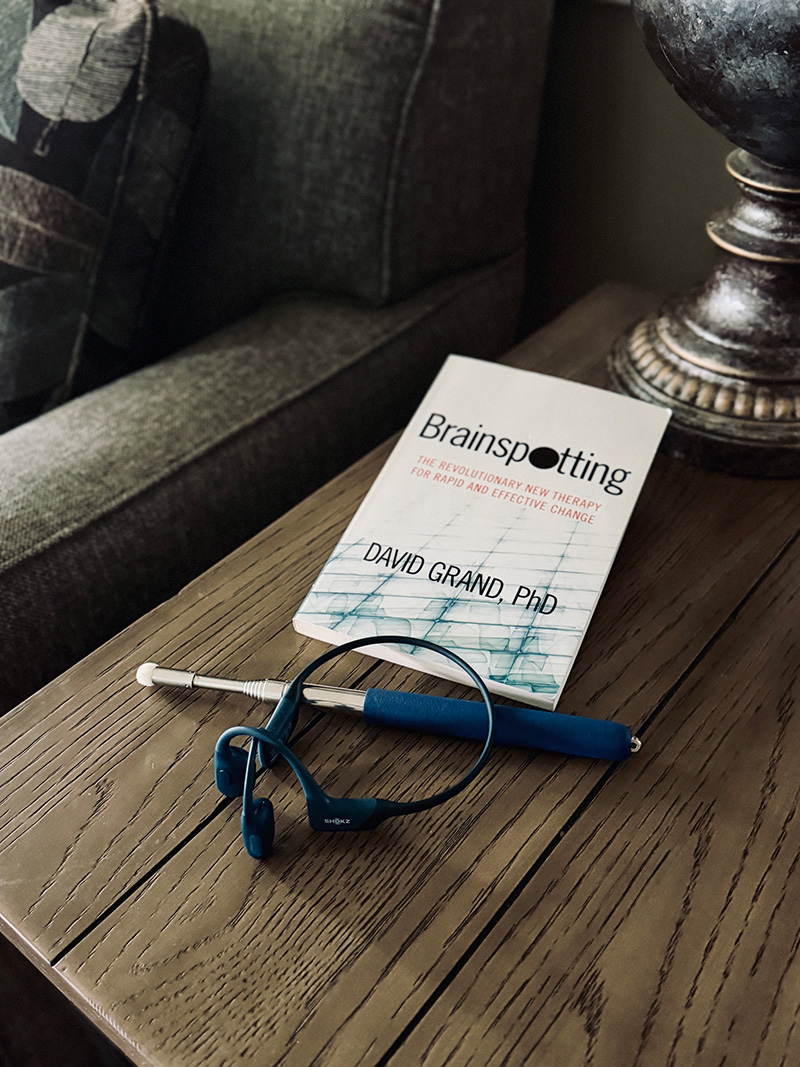
The brainspot is the specific eye position that most directly activates what you're working on. Using a pointer, we explore your visual field while you stay connected to the sensations and emotions associated with the issue. When the right position is found, there's usually a noticeable internal shift. That's the entry point.

03

Deep Processing

This is where the deeper work happens. With your gaze fixed at the brainspot, you focus inward on the sensations, feelings, and images that come up. There is no need to narrate or explain. Biolateral sound, heard through headphones, often accompanies the process and supports deeper neurological engagement. The nervous system does the processing; the therapist's role is to witness what's unfolding.

04

Integration

The end of each session includes time to come back to the room, check in with how you're feeling, and begin to make sense of what came up. It's worth knowing that Brainspotting processing often continues well after a session ends. Insights and shifts can emerge gradually over the hours and days that follow, as the nervous system carries the work forward.

Brainspotting pointer and headphones
What the mind cannot yet explain, the body often already knows how to release.

No two Brainspotting sessions are exactly alike, because no two people process the same way. Some bring vivid imagery or strong emotion; others feel quiet and subtle, with shifts that only become clear afterward. The process is self-directed in a meaningful sense: the nervous system leads, and the therapist holds the space for whatever needs to emerge.


What people
often ask

I thought healing required talking about what happened. Why doesn't Brainspotting?

Talking has been the cornerstone of therapy since Freud, and for good reason. Conversation, reflection, and being truly heard are powerful forces in healing. But neuroscience has expanded our understanding of where certain kinds of pain live. Much of what the body holds from overwhelming experiences is stored in brain regions that operate below language and conscious thought. Talking can describe what happened, but it often can't reach where the experience is actually held. Brainspotting works directly with those deeper structures — not instead of conversation, but through a pathway that doesn't depend on it. That means you won't be asked to recount what happened in detail or find the right words before you can begin. If anything, not having language for what you're carrying can be a signal that this approach is particularly well matched to what you're bringing.

How is Brainspotting different from EMDR?

Both approaches use the eyes as an access point and share roots in trauma treatment, but they work differently. EMDR (Eye Movement Desensitization and Reprocessing) involves alternating bilateral eye movement to stimulate both hemispheres of the brain. Brainspotting uses a fixed eye position: a specific point in the visual field corresponding to where a given experience is held in the brain. The two are distinct approaches, though each has shown effectiveness in trauma work.

How will I know when I've found a spot?

Finding the spot is a collaborative process. As the pointer moves slowly across your visual field, you stay connected to the issue you're working on and notice any shift: a change in body sensation, a moment of heightened emotion, or simply a place where something feels different. At the same time, I'm watching for subtle signals that appear in your body before your conscious mind registers them: a blink, a change in breathing, a slight shift in expression. A quiet shift in how something feels is often exactly what we're looking for.

How many sessions does it take?

Brainspotting is often used as a focused, relatively brief approach, and early studies suggest significant shifts are possible in just a few sessions. How many you'll need depends on the nature of the issue, how much layered history is involved, and what your goals are. Brainspotting can also be woven into longer-term therapeutic work rather than used as a standalone short course.

Ready to Begin?

Curious whether Brainspotting
is right for you?

If something on this page resonates, reach out. We can talk through what's brought you here, whether Brainspotting might be a good fit, and what getting started would look like.

Currently accepting new clients.

218.514.4415